How the Pricing Plans work?

This article contains everything you must know about the pricing plan feature and it’s broken down into the following topics.

  1. What are the Pricing Plans
  2. How to create a Pricing Plan
  3. How to choose different Pricing Plans styles
  4. How can a user change the Pricing Plan
  5. How can an admin change a Pricing Plan
  6. How to enable recurring (subscription) payments
  7. How to create the category-based pricing plans
  8. How to create monthly and annual pricing plans
  9. How to create a discount coupon for pricing plans

1. What are the Pricing Plans

Pricing Plans is one of the core directory features which allows directory admins to monetize by charging business owners a one-time fee or a recurring fee. It also allows the Free Plan option for a limited time or unlimited time. As an admin, you can let a Free pricing plan expire which will automatically unpublish a listing and a user will need to pay and upgrade to a premium plan in order for the listing to be published.


2. How to create a Pricing Plan

1 – Enable Pricing Plan Option

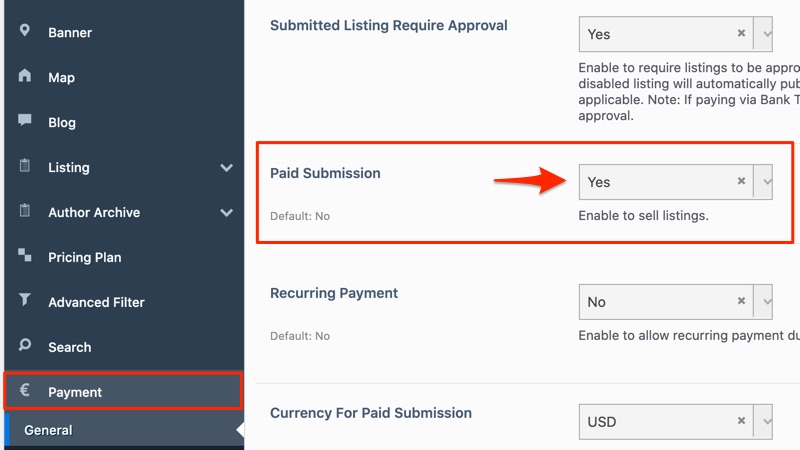
Before you create a plan you need to first enable the pricing plan option under Themes Options.

Go to Theme Options > Payment > General and next to Paid Submission select YES from drop-down and Save.
2 – Add a New Pricing Plan

Go to WordPress Admin and from left click Add New Price Plans under Pricing Plans.
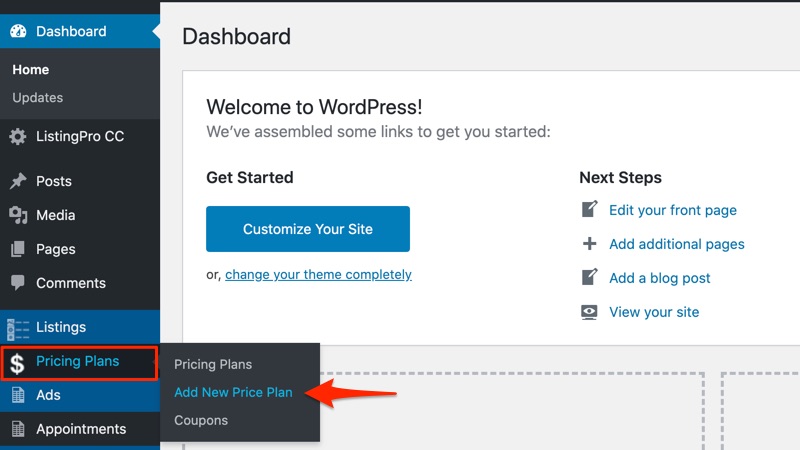
Title: Give a suitable title (example: Free, Premium, or Professional)

General Options

Background Image: Only available for styles Vertical View 1, 2, 3 and Horizontal View 1)
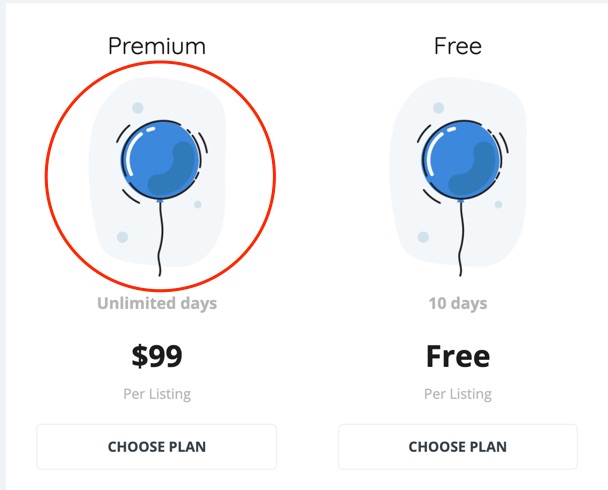
 

Add More: Add as many custom fields you want to display in a Pricing Plan (example: My New Option 1). They will all be added towards the end of the list of options.
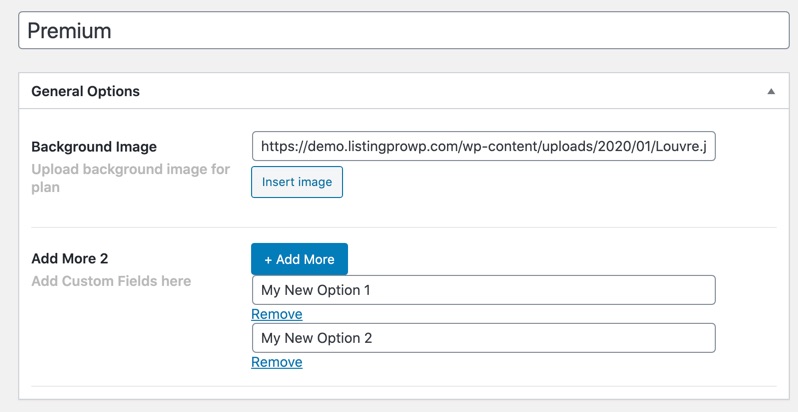
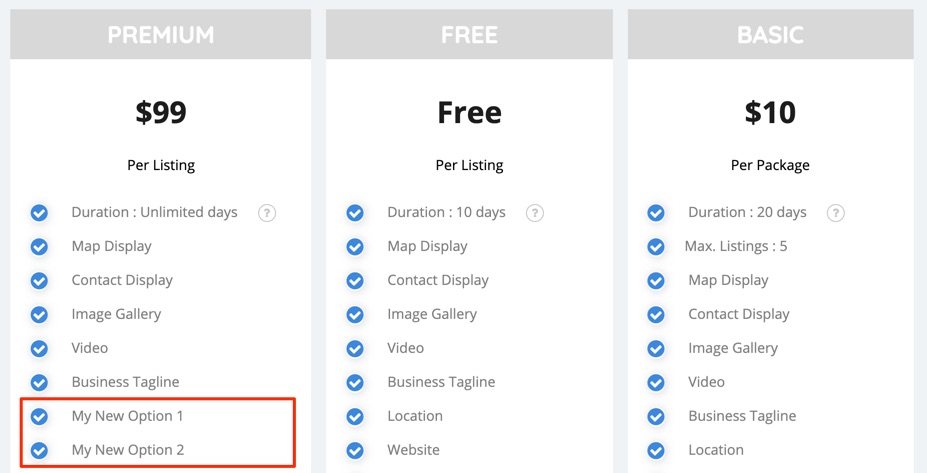
Backend View


frontend View


Enable/Disable Listing Fields By Plan

In almost all cases when creating pricing plans you will have to make sure that each pricing plan is unique. For example, if a Free Pricing plan only allows basic contact information to be submitted by a user then the Premium Pricing Plan offers advanced features like Booking or Events and so on.

As an admin, you will have full control in defining each plan to suit your business directory need.
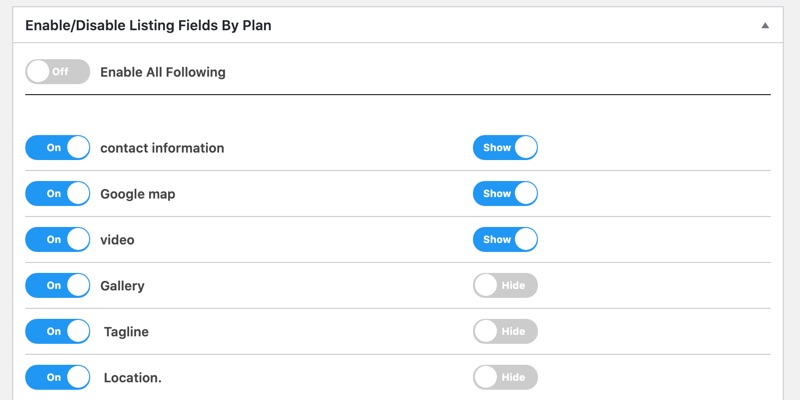
Full list of all the features you can control from Pricing Plan

  • Contact Information (This is only for Phone#)
  • Google Map (Also for Open Maps)
  • Video
  • Gallery (Not for Featured Image or Business Logo)
  • Tagline
  • Location (For City or Region added by admin or Google Locations)
  • Website
  • Appointments
  • Lead Form
  • Social Media links
  • FAQs list
  • Price Range
  • Tags or Keywords
  • Business Hours
  • Reserva Booking
  • Timekit Booking
  • Menu
  • Announcement
  • Deals, Offers, Discounts
  • Competitor campaigns on Listing Detail Page
  • Events in listings
  • Hide Google Ads
Package Type

There are two types of Pricing Plans.

a. PAY PER LISTINGS

If you select Pay Per Listing when creating a pricing plan then during listing submission a user (example: Listing owner) will only pay for ONE single listing and can create ONE listing.

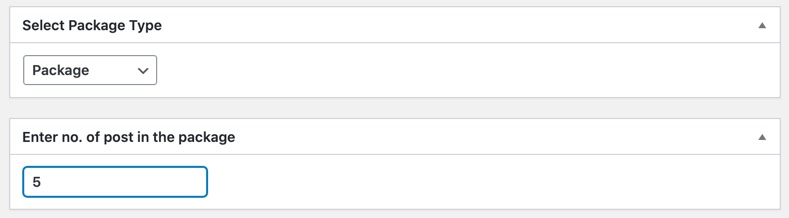
b. PACKAGE (Credits)

If you select Package when creating a pricing plan then during listing submission a user (example: Listing owner) will pay for multiple credits. The limit is set by an admin (example: 5 listings per pricing plan). Users can add new listings until they run out of credits.
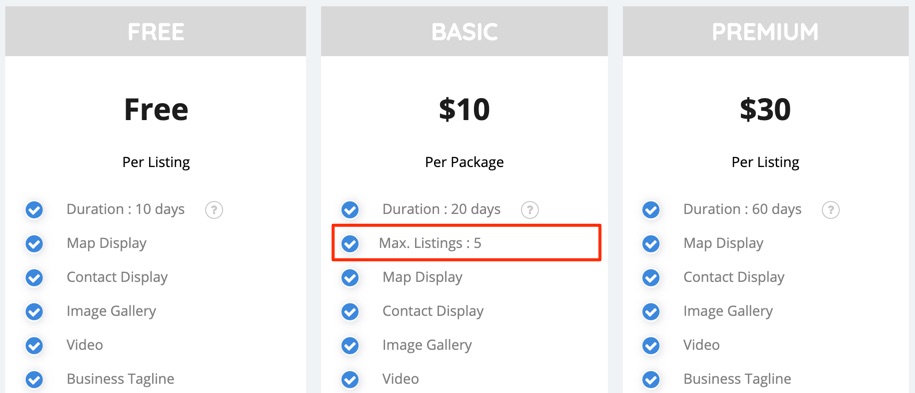
How does it show the number of credits in a package?

The credit (example: 5) set by an admin is shown in the pricing plan during the front-end listing submission process, as shown in the figure below.)
 

Descriptions

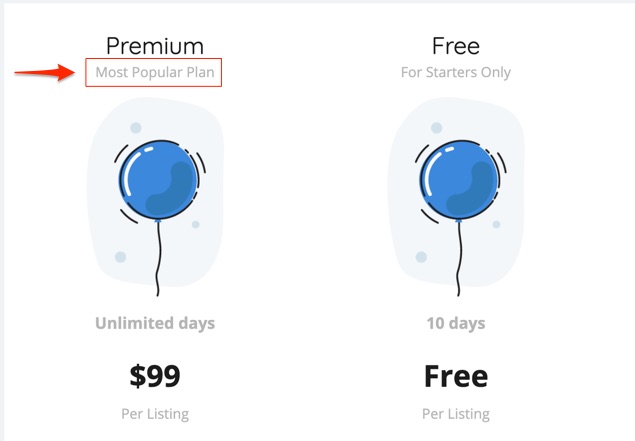
This short description option only works with a few pricing plan styles (Vertical View 2 and 3).
Background Color

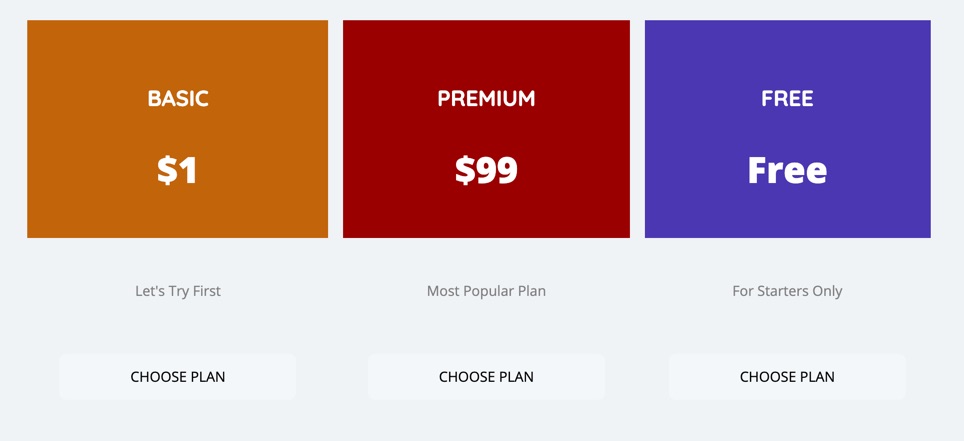
The background color option only works with a few pricing plan styles (Vertical View 1, 3, and Horizontal View 1).
Set Image Gallery Limit

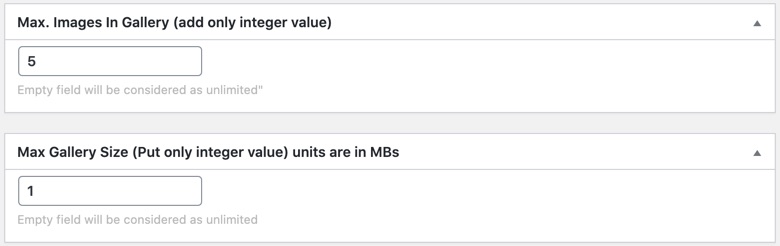
As an admin decide what should be the images upload limit. There is an option for both the number of images and the size of each image. In the below example the user can only upload up to 5 images and each image must be 1 MB maximum.
Set Price

The plan can be either a FREE or a PAID plan. If it’s free then skip and leave it blank. If it’s a paid plan then enter a number (example: 99) and do not include any currency symbol.

Set Duration

Set the value in the number of Days Only.

Examples:
7 = 1 Week
30 = 1 Month
365 = 1 Year


Allow continuing Free Plan after it expires

Check if you want users to continue with a FREE plan after the Free plan expires. Once their plan expires they can go to their dashboard and select Change Plan and select the FREE plan from the list.


Set it as Hot Plan

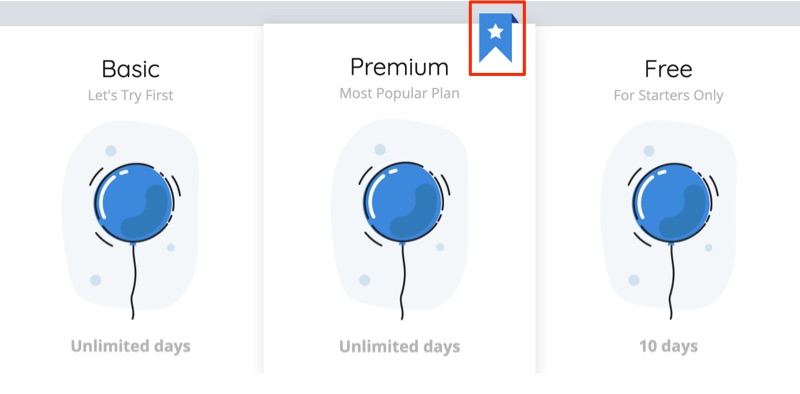
If you enable this option a text or icon banner will be added to the plan to highlight the plan.


3. How to choose different Pricing Plan styles

To choose Pricing Plan styles, go to the pricing plan page and edit the page with a Page Builder (Elementor or WPBakery) and select various different available styles.

1. ELEMENTOR PAGE BUILDER

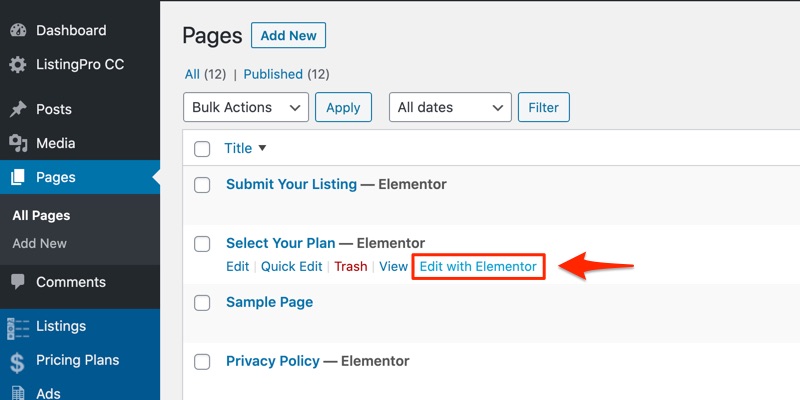
Go to the WordPress backend > Pages and click Edit with Elementor (or Edit with WPBakery)
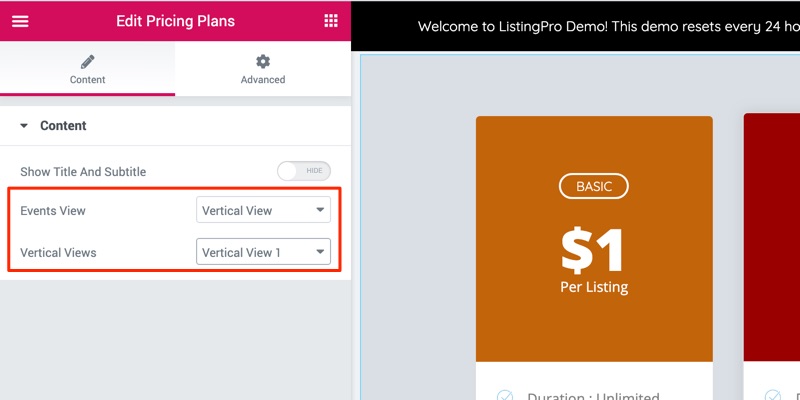
Select the pricing plan element on the page, then choose an orientation (vertical or horizontal) and a style.
 

WPBAKERY PAGE BUILDER


STEP 1: Login to WordPress admin dashboard.

STEP 2: Go to Pages > Select Your Plan page.

STEP 3: Find WP Bakery element called Pricing Plans and click Edit icon as shown below.
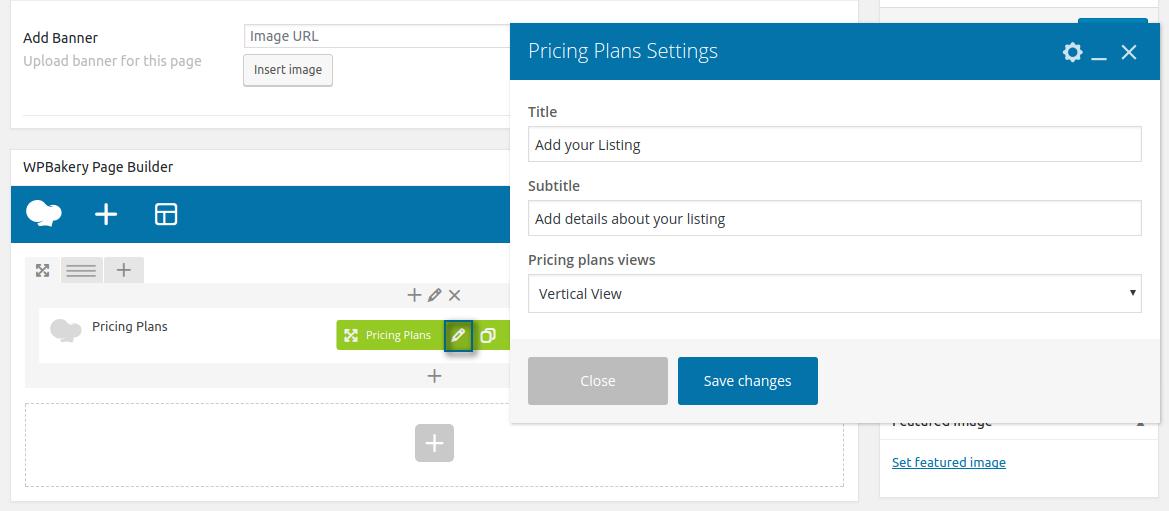
STEP 4: Select a Pricing Plans style.

STEP 5: Click Save Changes

STEP 6: Click Update


4. How can a user change the Pricing Plan


Suppose you have two pricing plans, one is Plan A ($10) and the other is Plan B ($30). If a user wants to change and upgrade their plan from $10 to $30 to avail more features, the user must follow these instructions:

STEP 1: Go to frontend user dashboard > Listings, and select  Change Plan

Once the user clicks on the change plan, it will show the details of the currently active plan.

STEP 2: To change the plan click Proceed Here

When upgrading any plan, the user has to pay the full amount.

If a user has bought the Plan A for $10 and wants to upgrade to Plan B for $30, they will be charged $30, and this will be processed as a separate transaction. The previously charged $10 (before changing the plan) will not be adjusted automatically, so they will have to pay the full amount of $30.


5. How can an admin change a Pricing Plan

This needs to be done from the backend. But when adding or editing a listing from backend you won’t have an option to select a pricing plan. The good news is that the option is there but it’s hidden so only who needs it and understands the consequences of changing this setting must enable it.

STEP 1: Go to wp-content\themes\listingpro\assets\css\admin-style.css

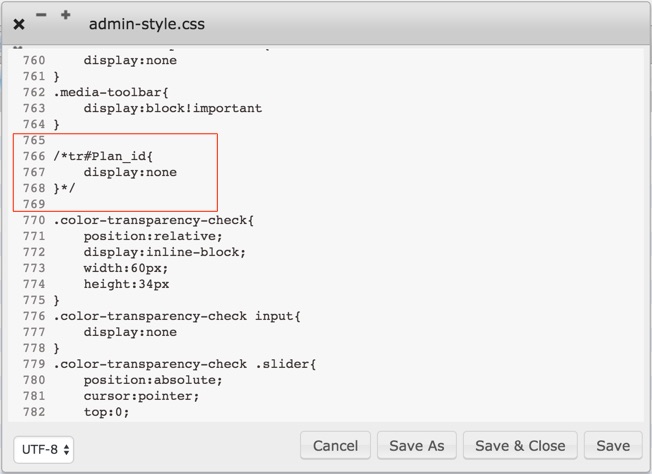
STEP 2: Scroll down to line 765

STEP 3: Hide or remove the following CSS.

 tr#Plan_id {display:none}

To temporarily enable this feature simply add /* before and */ at the end. See below for example.

/* tr#Plan_id {display:none} */
STEP 4:
Go to any listing and verify the Pricing Plans option is available.
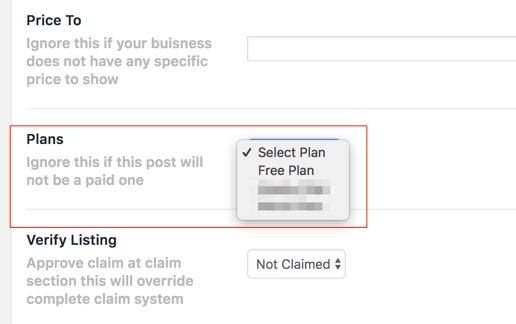
STEP 5: Select an appropriate plan and Save.


6. How to enable recurring (subscription) payments

Recurring (Subscription) payment option only works with Stripe, PayPal, and PayStack.

To enable & manage recurring billing based subscription in ListingPro please follow the below steps:

  1. FOR ADMIN: Enabling Recurring Billing
  2. FOR ADMIN: Listing Subscription Management
  3. FOR LISTING OWNER: Listing Subscription Management

FOR ADMIN: Enabling Recurring Billing

Before enabling recurring option you have to create a paid pricing plan. 

STEP 1: Go to Dashboard > Pricing Plans > Add New Price Plan
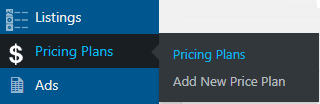
STEP 2: Create a new price plan and choose Select Package Type > Pay Per Listing while creating the price plan.
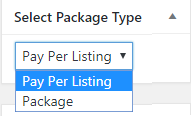
 

It is applicable for Pay Per Listing type only. So it’s required to choose ”Pay Per Listing” as the type of price plan. Otherwise, the recurring option will not be visible on the checkout page.

STEP 3: Make sure the Price and Duration are set correctly.

Setting a Price

The plan cannot be a FREE, it must be a PAID plan. Enter a number (example: 99) and do not include any currency symbol.

Setting a Duration

Set the value in the number of Days Only.

Examples:
7 = 1 Week
30 = 1 Month
90 = 3 Months
365 = 1 Year


STEP 4: Complete rest of the options and click Publish

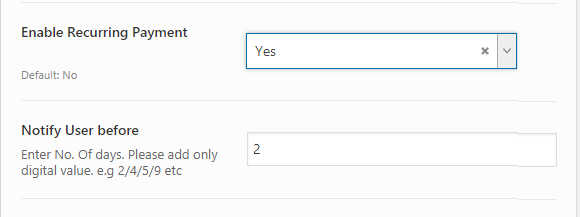
STEP 5: Now enable recurring option from Theme Options > Payment Settings > General > Enable Recurring Payment > Yes

STEP 6: Enter the number of days inside of the Notify User Before box. The user will be notified of every recurring billing amount before being charged prior to the number of days.


STEP 7: Go to Theme Options > Payment Settings > Stripe Settings and enable stripe as Live mode. Insert Stripe Live Secret Key and Live Publishable Key.
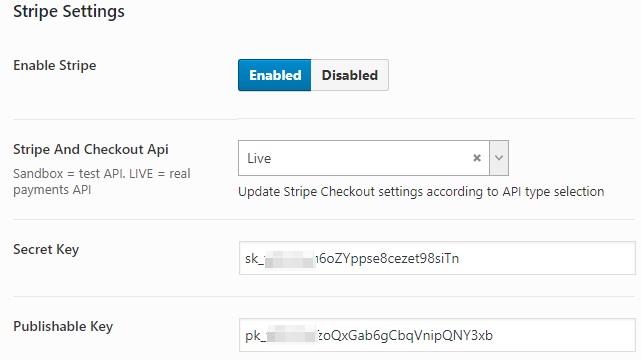


To generate the Stripe API Key please check the following article: How to Generate Stripe API Keys
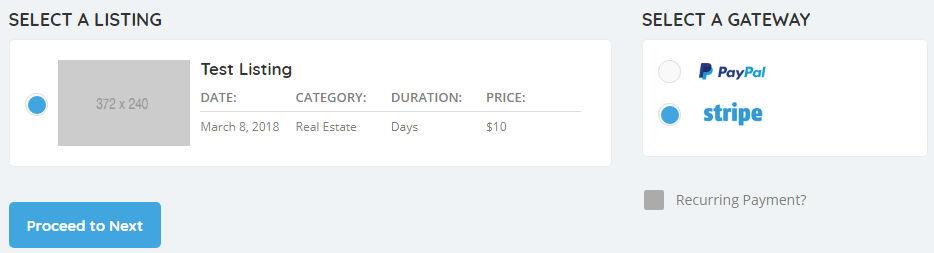
If everything is configured correctly then the recurring billing option will be visible as per the screenshot is given below:


FOR ADMIN: Listing Subscriptions Management

When a user will use Stripe payment method with the recurring option and processes the transaction successfully, a generated invoice will be sent to the user’s email. Transaction details will be available on the backend Subscriptions page. Admin can manage subscriptions from there.

 

Recurring billing subscriptions will only happen if the recurring option is checked during the listing subscription with payment.


FOR USER: Listing Subscriptions Management

If a user has a subscription, it will be shown on the user dashboard under the “My Subscriptions” tab. There will be available a list of all active subscriptions running by the user. A customer can stop subscriptions from their dashboard. Admin has also the power to cancel subscriptions of any user at any time through the admin panel.

To manage subscriptions:

STEP 1: Go to frontend user Dashboard > My Subscriptions

STEP 2: Refer to the Action column and click Unsubscribe.
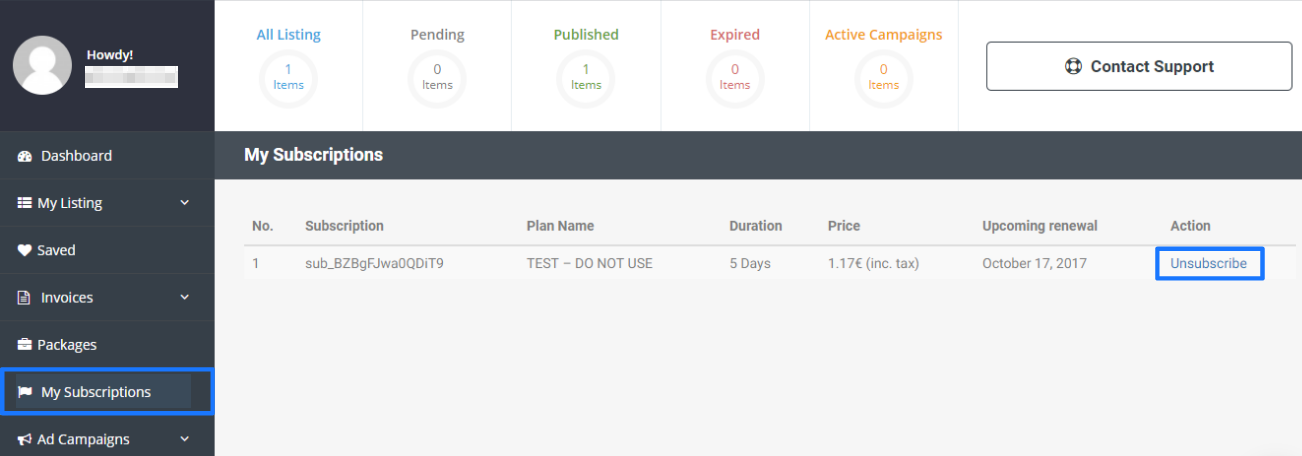
 

To cancel any subscription, firstly it’s required to unsubscribe it from your dashboard before removing subscriptions from stripe account.


Recurring option is not available for ad campaigns. Because it’s optional to activate ads after a period, but listings have to renew after a period.
For claims, no payment methods are involved yet, but for package upgrades/change invoices are generated. Please keep in mind that in the admin panel, it will only show those subscriptions which are paid by users through that particular site.


How to create the category-based pricing plans

Category based pricing plans give a lot more control over how to monetize by charging a single category or a group of categories at a different price than the rest. It basically breaks it into Standard and Exclusive plans.

Activation

Go to Theme Options > Pricing Plan and enable Category Specific Plans feature.
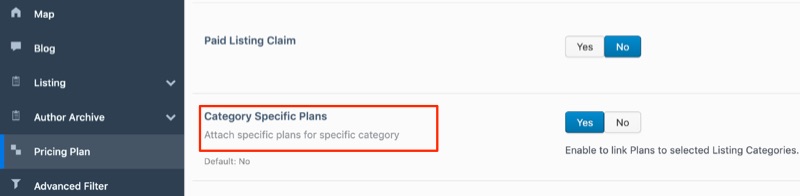
 

Configuration

Add or edit a pricing plan and now a new option called Plan Usage will be available with General as the default settings. From the drop-down menu select By Category

Select one or multiple categories and Save.

 

Verifying

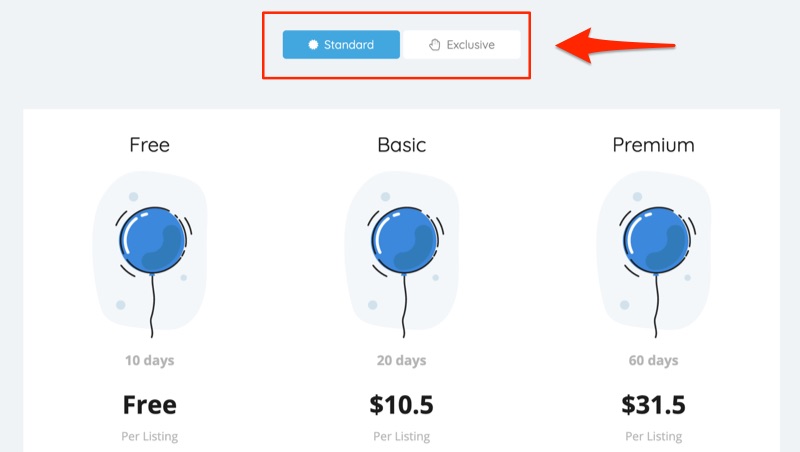
Go to the pricing plan page. An option to switch between all Standard Plans and Exclusive Plans will be now available.
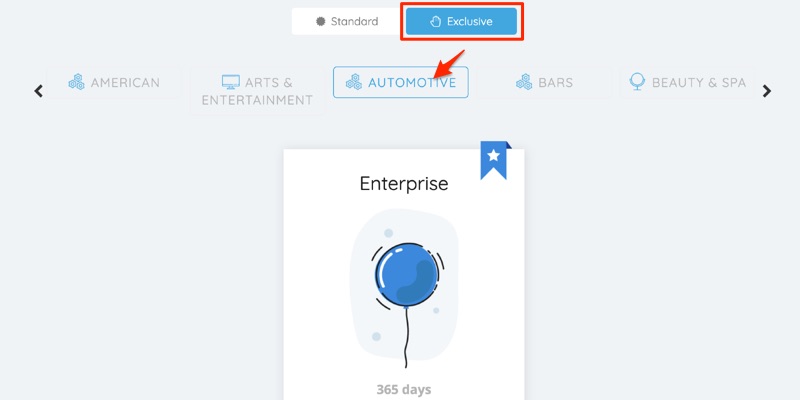
Switch to Exclusive tab and select a category (example: Automotive) to only show the plans associated with that category.


How to create monthly and annual pricing plans

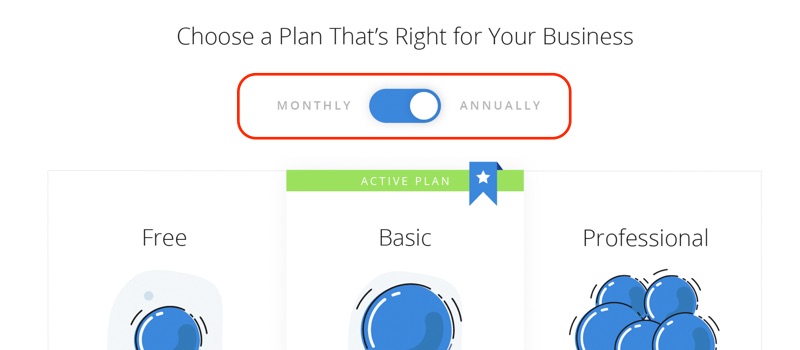
By offering monthly and annual pricing plans you increase chances of conversion by offering them a discount on annual pricing plan which helps with customers retention.

Activation

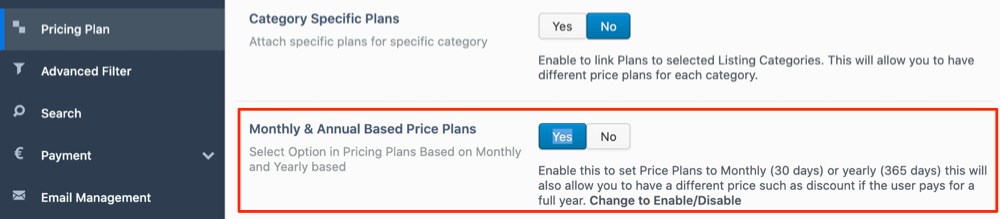
Go to Theme Options > Pricing Plan and enable Monthly & Annual Based Price Plans feature.
Configuration

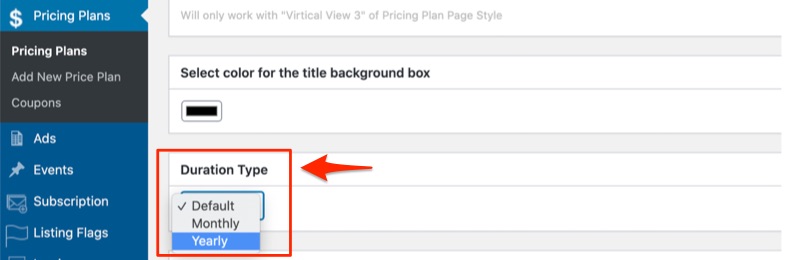
Now a new option called Duration Type will be available with the following options from the drop-down: Default, Monthly, and Yearly.

You will have to create two plans with the same name for example Startup but for one of the plans add an asterisk to differentiate. For example, the Monthly plan will be Startup and the Annual plan will by Startup* (with asterisk) to avoid any confusion.

From the drop-down menu select Monthly or Yearly.
Give a price to monthly and annual plans. It’s recommended to give a discount on the annual plan. For example if monthly pricing plan is $10 then the annual pricing plan should be $100 and not $120. This is just a suggestion you can set the price as you wish.

Now Save.


Test by adding a new plan and you will see the monthly and annual switch.


How to create a discount coupon for pricing plans

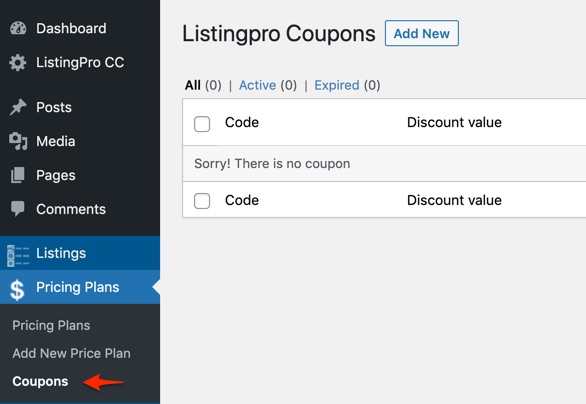
Go to WordPress admin > Pricing Plans > Coupons
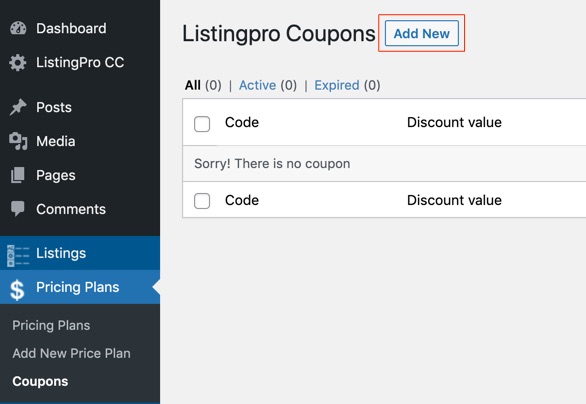
Click Add New
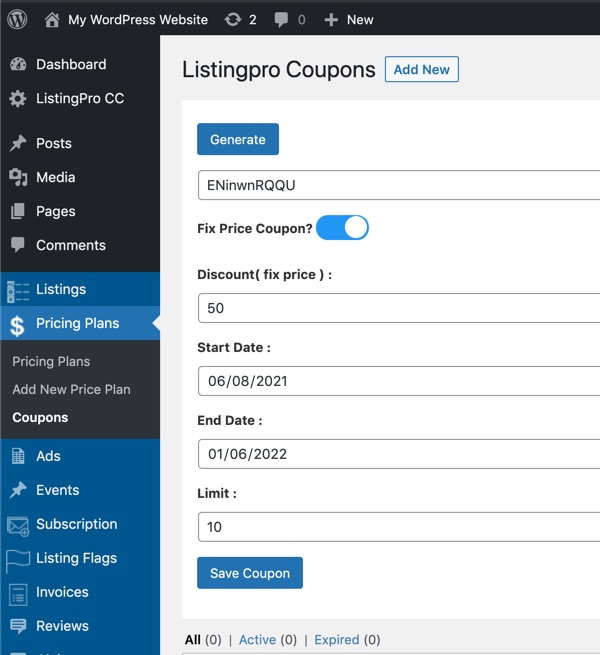
Fill the form and hit the Save Coupon button
 

How to leave us a rating and review?

In this article, we will show you how to share your experience with ListingPro on the Envato marketplace.

STEP 1: Login to ThemeForest.

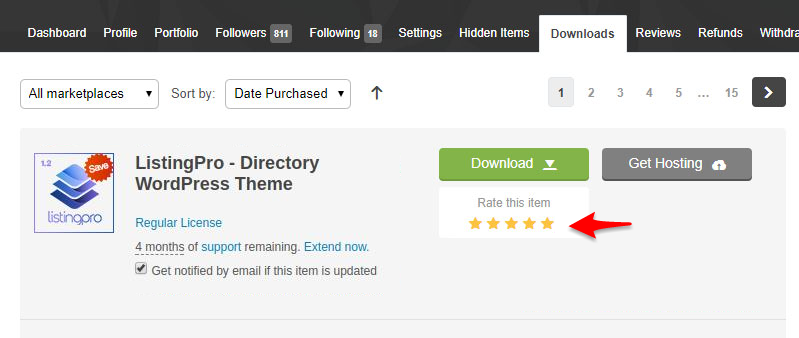
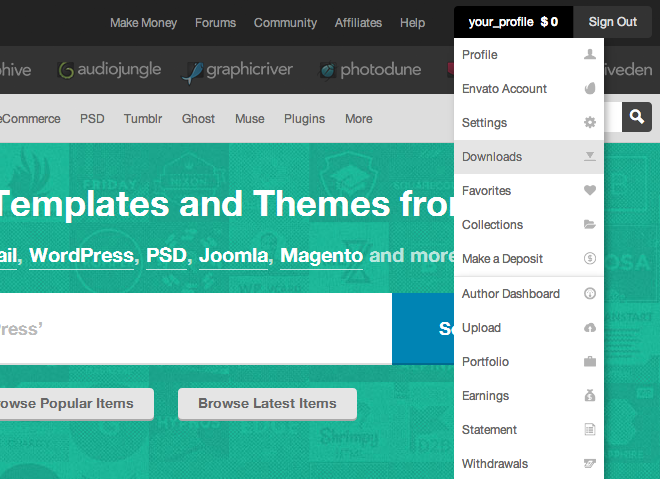
STEP 2: Click on your profile name in the top-right corner.

STEP 3: Click Downloads

STEP 4: Below the Download button, click the star rating.

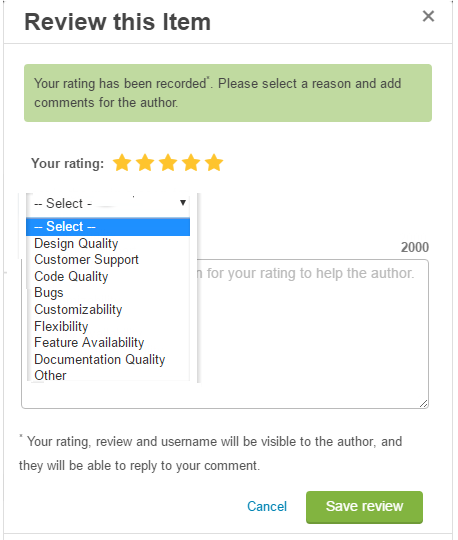
STEP 5: Select the Main reason for your rating,  and write few words about your experience in the comments box.

STEP 6: Click Save review

For inspiration, you can see what other people are saying about ListingProGo here.

Leave us your Review, share your experience building your dream directory startup. We’d love to hear from you, how did you feel while on support channel, after each new updated feature, the difference between your last theme compared to ListingPro, etc.

You can now also share your feedback with PROS and CONS via Capterra – Go here.

What is Claim Listing?

Now Paid Claim feature is also available.
  • What is Claim Now Feature
  • Why Should Someone Claim a Listing
  • How Free Claim Works
  • How Paid Claim Works
  • Change Claimed Badge Name

What is the Claimed Badge?

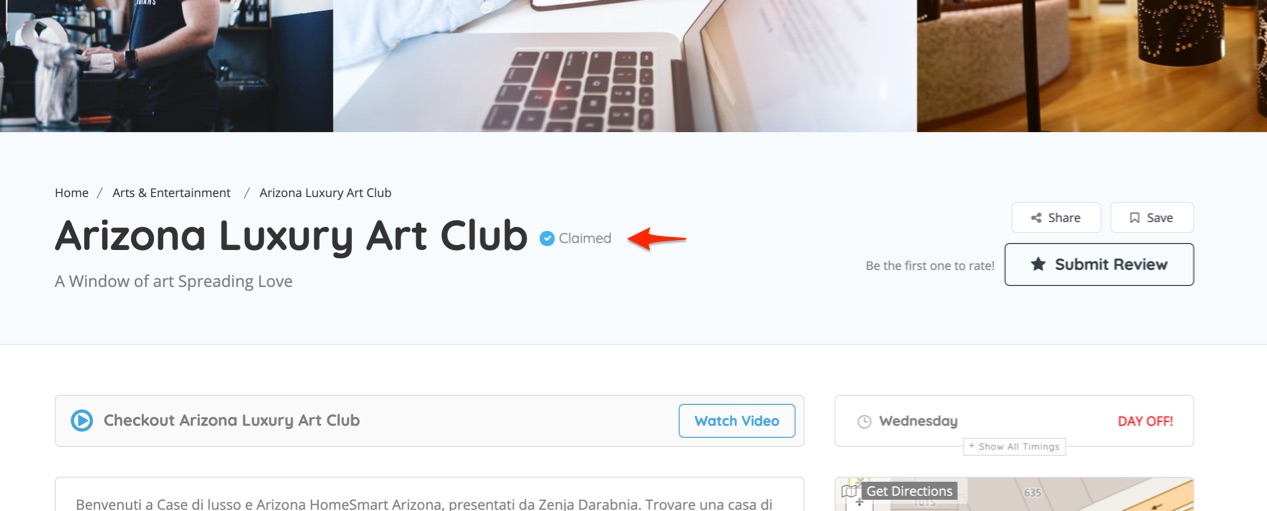
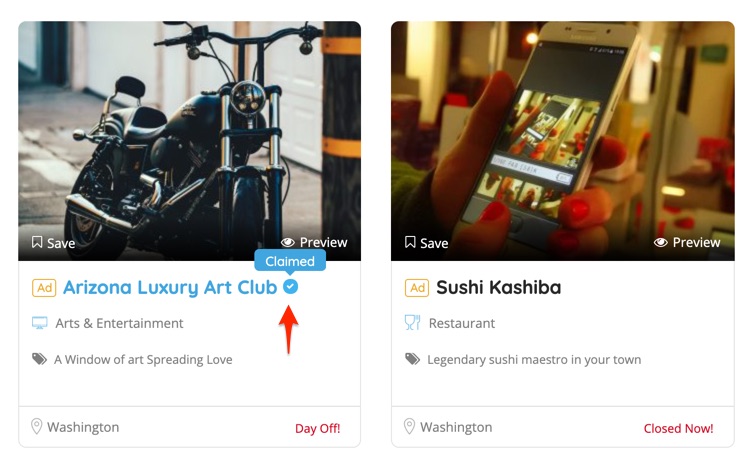
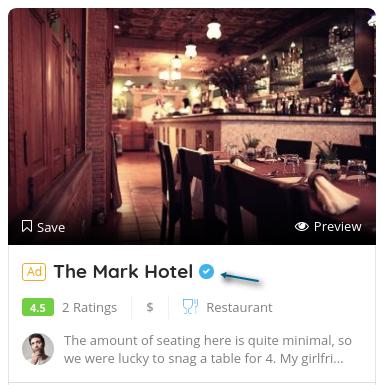
The Claimed badge helps businesses distinguish and stand out from the others by establishing ownership by verifying with the website admin. Once the site admin verifies and accepts the claim & verification request, then only a business listing gets a Claimed badge.

There are two places the Claimed badge is visible.

1. Claimed badge on Detail Page


2. Claimed badge on Listing Card

Every business owner is not required but recommended to go through the claim process to make sure their business is not claimed by someone else and also to gain the trust of their customers. As a site admin, you can disable this feature.


Why Should Someone Claim a Listing?

New listing submission (Free or Paid) does not mean listing owner verification, only the admin can verify and grant access after a claim request is submitted.

Admins can certify if the claimed business has come from the true owner by verifying the details sent when claiming a listing. Unfortunately, due to the differences between countries and their laws, it’s recommended for the admin to include details on their FAQ and how to proceed and verify the ownership for a listing.

Having a listing claim process gives peace 0f mind to users that each listing is being verified by the website.

If your business doesn’t require to claim a listing, you can disable this feature.


How Free Claim Works?

Here’s a typical scenario where a user will claim a business listing. If a business is already listed in a directory, the business owner can request to claim their business listing by verifying and establishing their identity as a real business owner to get the most out of a directory.

For example, John runs a pizza shop in downtown called Best Pizza Place and he comes across your awesome directory called downtown-pizzerias.com, where you list all the pizza shops in the downtown area.

John finds his pizza shop is already listed on the-downtown-pizzerias.com but he doesn’t have access to manage the listings, he can request access to the listing by clicking the claim now button and submitting the claim form.

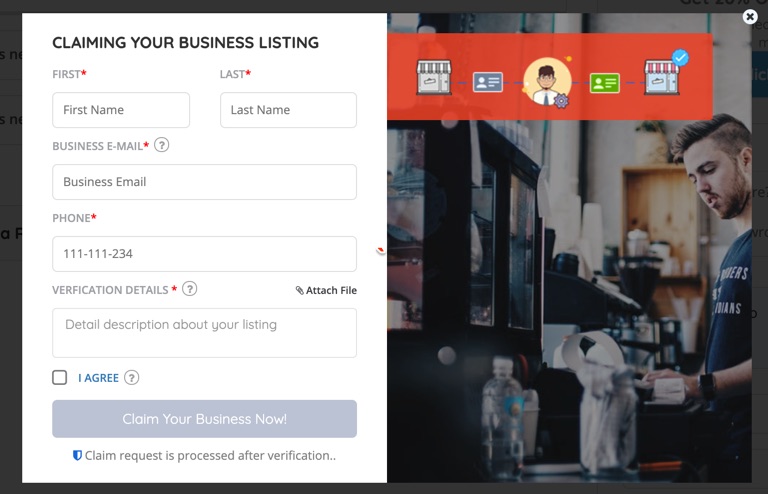
Once signed in user can claim by filling out the form with the additional details for verification based on the local guidelines and policy.

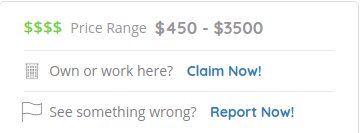
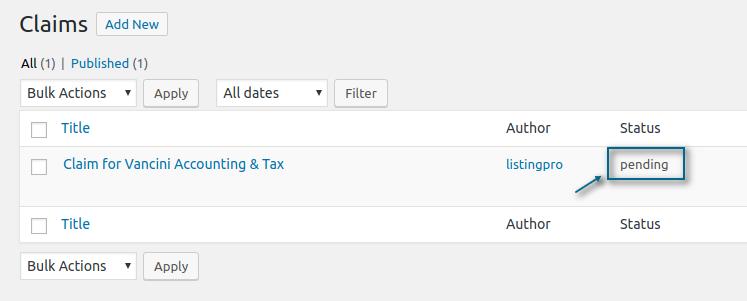
The site-admin needs to review and approve the Claim requests as shown below:

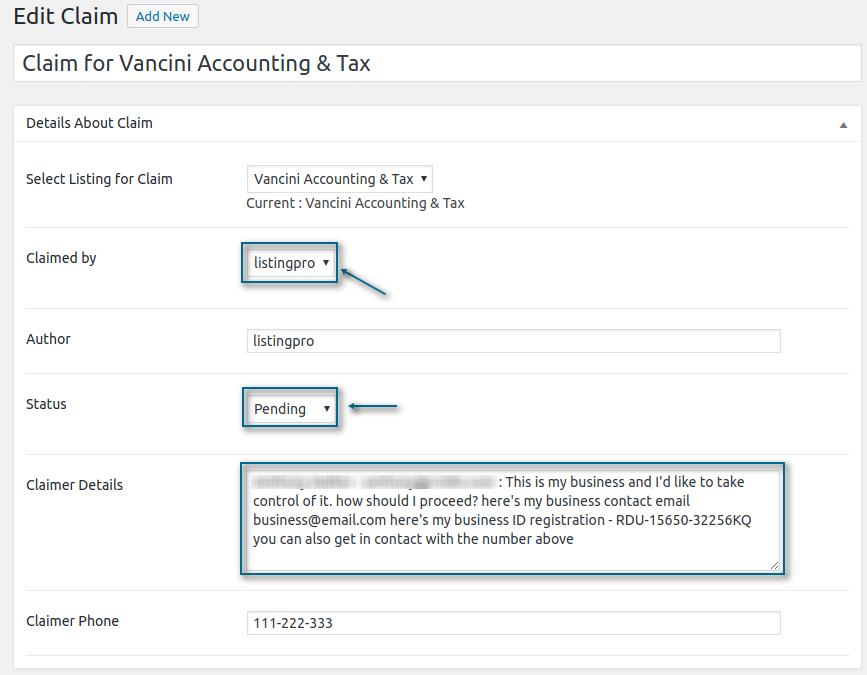
by simply clicking on the listing title, you’ll be able to edit the Claim and change the Status accordingly

Once the claim is approved the Claimed badge will show next to the listing name and the option to claim will disappear.


How Paid Claim Works?

Only once the admin approve he will be sent an email stating the claim has been approved to process the payment. The provided link in the email will take the user to checkout to make the payment. Once the payment is completed then the listing will get the Claim badge.


Change The Claimed Badge Name

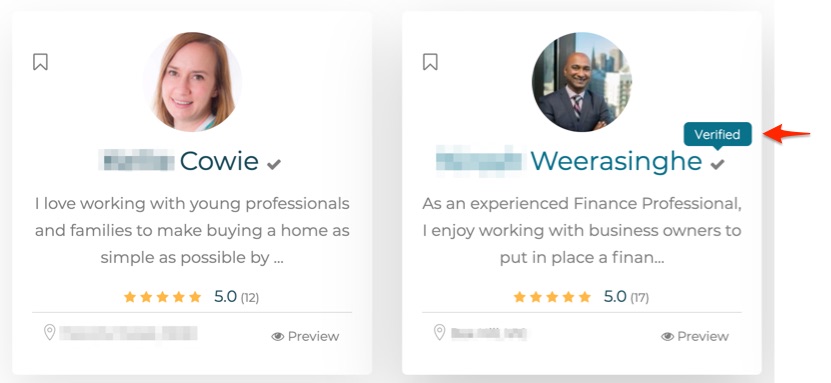
Yes, you can change the text from Claimed to Verified or something else. In the below example a ListingPro user has already done it.

What is PayPal error 10002?

issue
Based on the API you’re using, PayPal returned API error code 10002, accompanied by one of the messages described in the following paragraphs.

Causes and Solutions
This error usually happens when permissions are set incorrectly in your PayPal account. To allow a third party to make API calls on your behalf, you must explicitly grant them permission to do so. If you’ve already done this but you got error code 10002, your shopping cart configuration may be the cause. Your vendor needs to know the primary email address on the PayPal account for which they’re making the third-party API call. They must add this email address to the API script making the API call on your behalf.

If you’re making third-party API calls but not using a vendor and you still get this error, it can be because of the following reasons:

  • Incorrect API information – Follow this procedure to request API Signature or API Certificate credentials.
  • Passing a value in the Subject field – This field should be blank if you’re not making an API call on behalf of another person.

One of several different error messages accompanies error code 10002. You’re most likely to see this message:

  • 10002: Authentication/Authorization – Username/Password incorrect

This error occurs when you provide an incorrect API username and API password to the PayPal server, for example, if you:

  • Provide the username and password for your actual PayPal account, instead of your API username and API password. PayPal generates your API username and API password when you generate your API Certificate and Signature.
  • Use the same API information for the Sandbox and Live environments. You need to generate separate API information for your Sandbox and Live accounts.
  • Don’t update the endpoint to point to PayPal’s Live API servers.
  • Format your API Certificate as .txt instead of .pem.
  • Add trailing or leading whitespace on any of the characters.

One of the following error messages also may accompany code 10002:

  • 10002: Account locked – The user account is locked
  • 10002: Authentication/Authorization Failed – Account is locked or inactive
  • 10002: Internal Error – Account is locked or inactive
  • 10002: Internal Error – Internal Error
  • 10002: Authentication/Authorization Failed – Account is not verified
  • 10002: Authentication/Authorization Failed – API access is disabled for this account
  • 10002: Authentication/Authorization Failed – Client certificate is disabled
  • 10002: Authentication/Authorization Failed – Internal Error
  • 10002: Authentication/Authorization Failed – This call is not defined in the database!
  • 10002: Authentication/Authorization Failed – Token is not valid
  • 10002: Receiving Limit exceeded – You’ve exceeded the receiving limit. This transaction can’t be completed
  • 10002: Restricted account – Account is restricted

These errors occur because the credentials are incorrect or invalid. Make sure they’re entered correctly and, if possible, try again. If the problem persists or you can’t try again, contact your Account Manager or open a ticket with Merchant Technical Services.

If you get error code 10002 with the message 10002: Security Header Invalid, you have incorrect API credentials. Check that the account that will receive payments was used to generate the API credentials. If you’re using PayPal’s Sandbox environment, you must generate API credentials from within the Sandbox business account rather than a Live account.

You should also check that you’re submitting your request to the correct environment (Live vs. Test). For information on endpoints, see NVP/SOAP API endpoints. If you use a shopping cart, there’s often a switch on their end to change from Live mode to Test or Sandbox mode. Make sure that this switch is set to the correct environment. In addition, your shopping cart often manages endpoints, so consult your shopping cart provider for help.

Note: Any extra spaces or characters in the username, password, or signature can also cause the Security Header invalid error. Check for any extra spaces at the end of the password or signature; it’s common for them to be added when pasting credentials into your cart.


Requesting API credentials
Depending on your shopping cart requirements, you may need an API Signature or an API Certificate. Here’s how to request API Signature or Certificate credentials.

  • If you choose API Signature, you can copy the API username, password, and Signature. Then, paste this information into your shopping cart configuration or administration screen and click Done. You can view or remove an API username, password, or Signature anytime.
  • If you choose API Certificate, copy your API username and password and click Download Certificate. Save the file to your computer. Remember where you saved the file because you’ll need it later in your shopping cart setup.

Example NVP responses for error 10002

  • L_ERRORCODE0=10002
  • L_SHORTMESSAGE0=Security error
  • L_LONGMESSAGE0=Security header is not valid
  • L_SEVERITYCODE0=Error


How to edit Home banner?

This article contains everything you must know about configuring the blog and it’s broken down into the following topics.

  1. Home page Banner Text
  2. Change the search box text (what – where)
  3. Change the search bar’s main title
  4. Hero-header background Video format
  5. Fixing NULL error in WHERE field


1. Home page Banner Text

STEP 1: Log in to the WordPress admin dashboard.

STEP 2: Go to Theme Options > Banner Settings

Scroll to find all the fields to edit such as Banner Search Placeholder, Location Default Text, Search Top Title, etc.

STEP 3: Edit the text in appropriate fields.

STEP 4: Click Save Changes


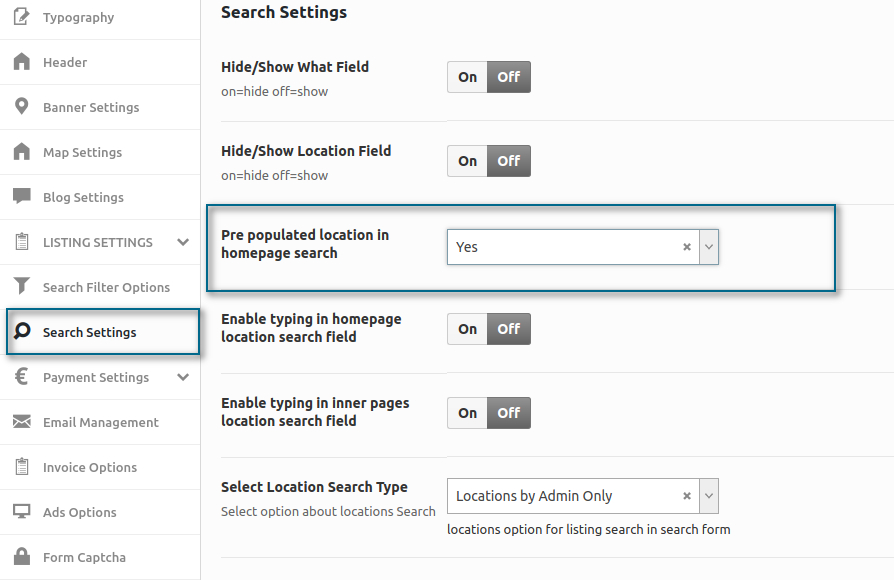
2. Change the search bar (what/where)?

STEP 1: Log in to the WordPress admin dashboard.

STEP 2: Go to Theme Options > Search Settings

STEP 3: Select whether you want to hide (What – Where) options in your homepage search

STEP 4: Hit save and sync.


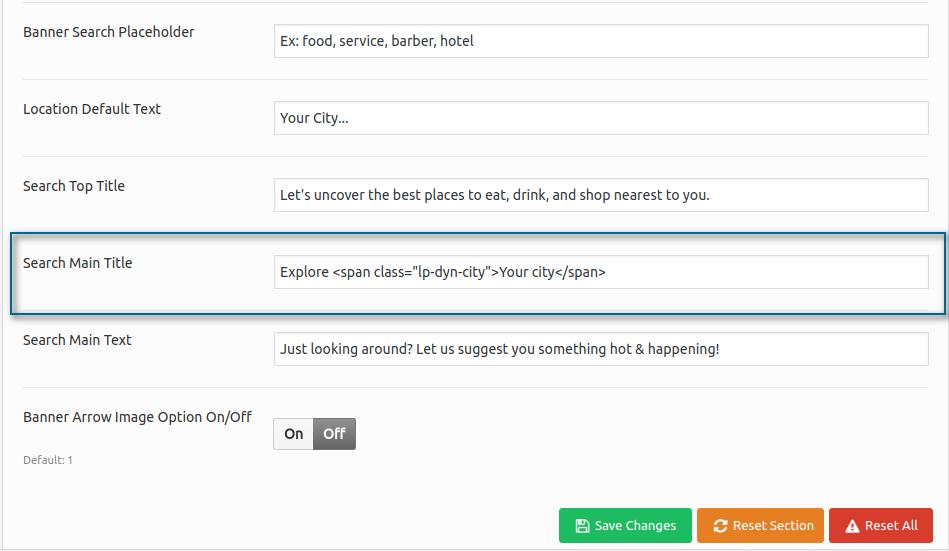
3. Change the search bar’s main title

If you still want to get dynamic access to IP ADDRESS but want to customize the box main title, kindly follow the following steps:

STEP 1: Log in to the WordPress admin dashboard.

STEP 2: Go to Theme Options > Banner Settings

See Screenshot below

STEP 3: Add a new title in the respective field

See Screenshot below

STEP 4: save changes

[custom-related-posts title=”Related Posts” order_by=”title” order=”ASC” none_text=”None found”]

4. Hero-header background Video format

Preferably MP4 format. You can edit your Video Banner the way you want to. There’s no limitation regarding time duration. But as we know, there should be included at least 30sec or 1min video.

More extended videos, may cause a delay on the screen, and users may face some instability during page loading.
Remember that the video should be added to your WordPress Media Gallery to parse the Video URL to your homepage directory


5. Fixing NULL error in WHERE field

When you click the target icon in the WHERE field, a script runs to find the city name against your IP address. If that script could not find any city name against your IP address then it returns NULL.

We are using geolocation-db.com which has a location database, which is based on IP addresses. Below is the calling URL that is triggered by click.

URL: https://geoip-db.com/json/geoip.php?jsonp=callback

Try the above URL to see your city name as shown below.

If your city name is not populated as shown in the above screenshot then we assume that there is no city name against your IP address in the GEO IP database. But if you do see the city name as shown in the screenshot but it’s not showing on your website then you can contact our support.

To change the search bar title from auto-detecting your city name, see How to remove location (city) from the search title?